
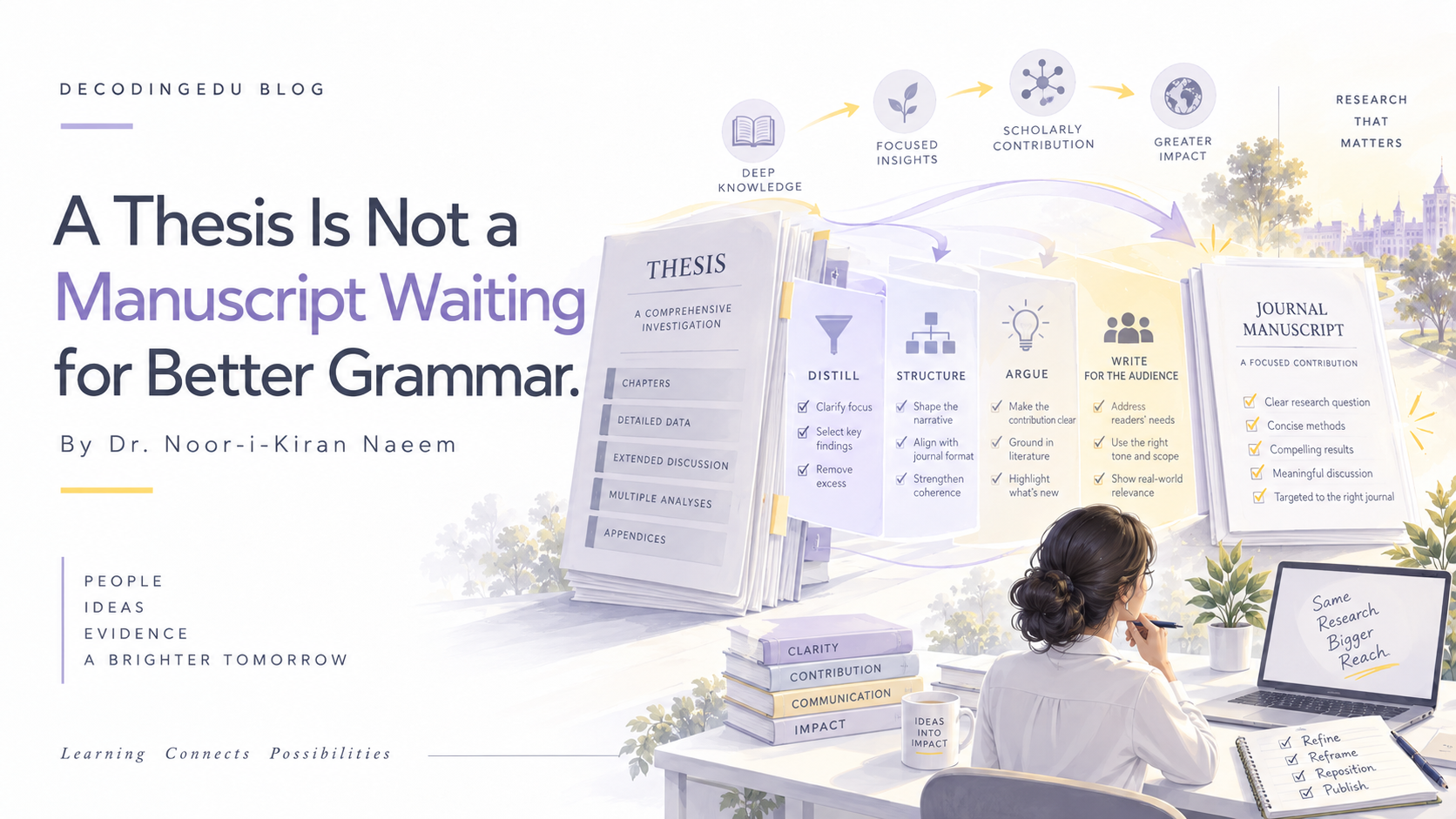
I have supervised a lot of postgraduate research. And one of the patterns I see most consistently is this: a student completes a strong thesis, passes their viva, and then — nothing. The work sits in a university repository, read by almost no one, contributing almost nothing to the field it was meant to advance.
This is a waste. And it is largely preventable.
Why Theses Stay Theses
The reasons are understandable. By the time a student has finished a thesis, they are exhausted. The viva is over. The immediate pressure is gone. The idea of going back into the work — reframing it, cutting it, rewriting it for a different audience — feels like more than they have left.
There is also a skills gap. Writing a thesis and writing a manuscript are genuinely different tasks. A thesis is written for examiners who need to see that you understand the literature, that your methodology is defensible, that you have engaged with every relevant consideration. A manuscript is written for readers who need to understand quickly why your work matters, what you found, and what it means for their practice or their own research.
The conventions are different. The length is different. The relationship to the literature is different. Many researchers — including experienced ones — find the conversion genuinely difficult.
Why It Matters
A thesis that stays a thesis reaches, at most, a handful of people. A manuscript in a peer-reviewed journal reaches the field. It enters the evidence base. It can be cited, built upon, challenged, replicated. It contributes to the collective knowledge that shapes practice.
In health professions education, this matters particularly. The field is still building its evidence base. Research conducted in under-represented contexts — in low- and middle-income countries, in non-Western educational systems, in resource-constrained environments — is systematically underrepresented in the literature. Every thesis from these contexts that does not become a manuscript is a gap in the evidence that the field uses to make decisions.
How to Approach the Conversion
The first thing to understand is that conversion is not editing. You are not taking your thesis and making it shorter. You are writing a new document that uses your thesis as its source material.
Start with the question: what is the one thing my research found that the field needs to know? Not the three things, not the nuanced picture — the one thing. That becomes your manuscript's central contribution, and everything else is organised around it.
Then ask: who is my reader, and what do they already know? A manuscript for a health professions education journal assumes a different baseline than one for a clinical journal. The literature review is not a demonstration of your comprehensive reading — it is a brief, targeted argument for why your question mattered and what was missing before you answered it.
The methods section is shorter. The discussion is more direct. The implications are more explicit. The word count is a constraint that forces clarity, not a limitation to work around.
The conversion is work. But it is work that transforms a private achievement into a public contribution. That is worth doing.