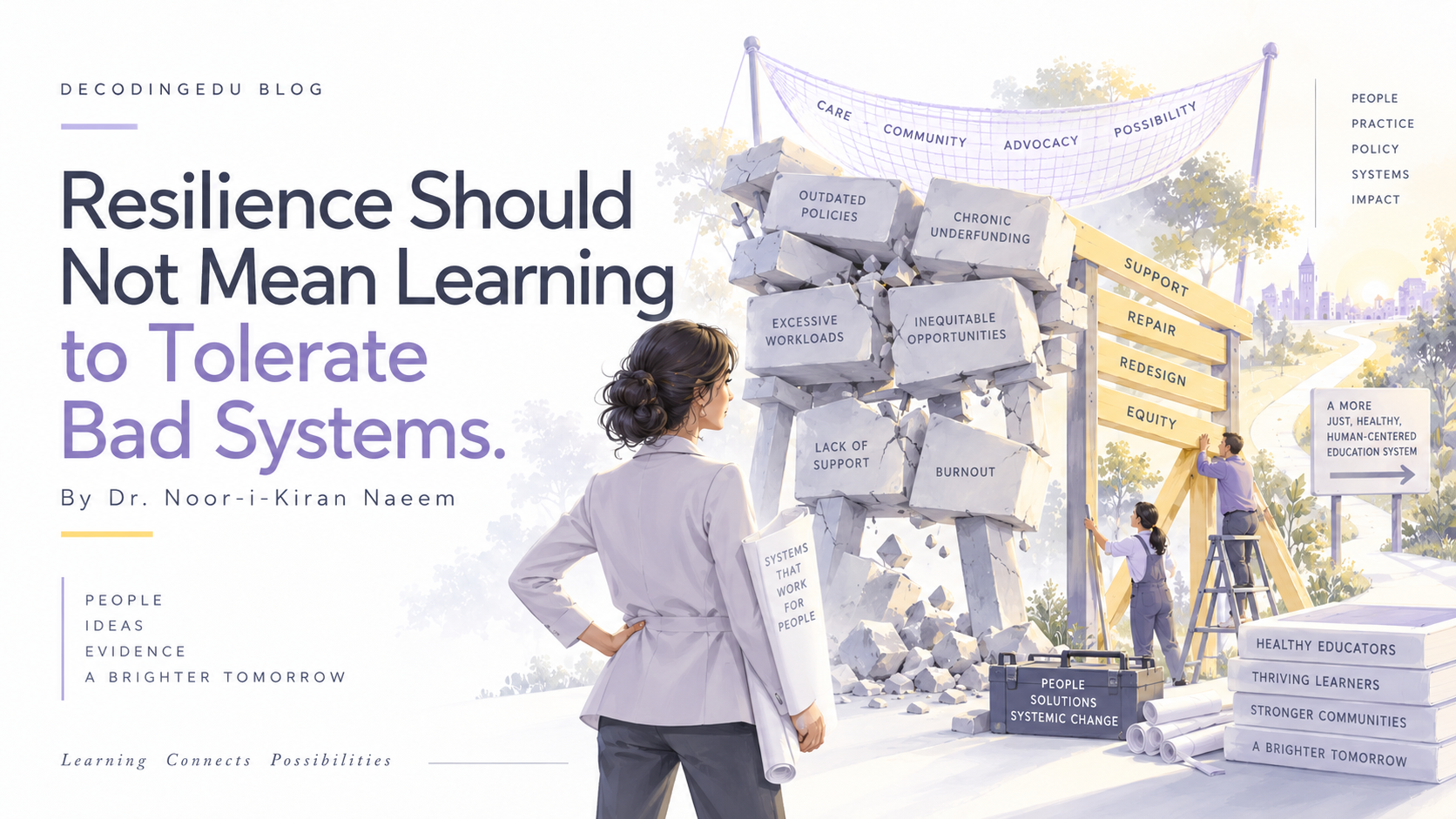
Resilience has become one of the most used words in health professions education. We teach it in curricula. We assess it in portfolios. We run workshops on it. And I think, in many of the ways we deploy it, we are doing something harmful.
Not because resilience is unimportant. It is. But because the way we frame it — as a personal quality to be developed in individual learners — often functions to redirect attention away from the systems that are making people need resilience in the first place.
The Individual Framing
The dominant model of resilience in health professions education treats it as a capacity that individuals either have or need to develop. You can build your resilience through mindfulness, through reflective practice, through developing a growth mindset, through building social support networks.
All of these things have value. I am not dismissing them. But when resilience is framed primarily as an individual capacity, the implicit message is that the problem of struggling in a difficult environment is, at least in part, a problem of insufficient personal development.
This is a significant misdirection. And it has consequences.
What It Obscures
When a medical student is struggling with the emotional weight of clinical training, the question we should be asking is: what is the environment asking of this person, and is that reasonable? When a junior doctor is burning out, the question is: what are the structural conditions producing this outcome, and who is responsible for changing them?
Resilience training, when it is the primary response to these questions, functions as a way of not asking them. It locates the problem in the individual and offers an individual solution, leaving the system intact.
This is not a neutral choice. Systems that produce burnout, that normalise mistreatment, that load impossible demands onto trainees — these systems benefit from a resilience discourse that asks their members to adapt rather than asking the systems to change.
What Genuine Support Looks Like
I want to be clear: I am not arguing against supporting learners. I am arguing for a different kind of support — one that is honest about what is systemic and what is individual, and that does not ask people to absorb the cost of broken systems as a condition of professional development.
Genuine support looks like: naming the structural problems clearly, rather than treating them as background conditions that individuals must learn to navigate. It looks like creating genuine psychological safety — not as a workshop topic, but as a lived reality in the training environment. It looks like holding institutions accountable for the conditions they create, not just the outcomes they produce.
And it looks like being honest with learners: some of what you are finding hard is hard because the system is hard. That is not a failure of your resilience. It is a failure of the system. You deserve better, and working to change it is legitimate — not a sign that you are not cut out for this.
Resilience matters. But resilience that asks individuals to absorb what systems should fix is not a virtue. It is a burden. And we should stop teaching it as if it were the same thing.