A Rapidly Shifting Landscape
Artificial intelligence is no longer a distant prospect for health-professions education. It is already here. From AI-assisted clinical decision support to large language models that can generate feedback, summarise literature and simulate patient encounters, the tools available to educators and learners are expanding at a pace that outstrips our collective capacity to evaluate them (Kung et al., 2023). This pace creates both opportunity and risk. The opportunity lies in personalisation, accessibility and the potential to extend high-quality educational experiences to learners in resource-constrained settings. The risk lies in uncritical adoption, the erosion of essential skills and the amplification of existing inequities (Meskó & Topol, 2023).
What AI Can and Cannot Do
AI tools are genuinely useful for certain educational tasks: generating practice questions, providing immediate feedback on written work, summarising complex texts, and supporting self-directed learning. These are not trivial contributions. For learners who lack access to responsive tutors or rich feedback environments, AI can be genuinely democratising (Bates et al., 2020). But AI cannot replace the relational dimensions of health-professions education. It cannot model professional identity, navigate the emotional complexity of clinical encounters, or provide the kind of contextually sensitive mentorship that shapes how learners understand what it means to be a health professional. These remain irreducibly human (Bleakley, 2014).
Ethical Responsibilities
Educators who adopt AI tools carry responsibilities that go beyond technical competence. They must be able to critically evaluate the outputs AI generates, recognising errors, biases and limitations. They must be transparent with learners about when and how AI is being used. And they must actively resist the temptation to use AI as a substitute for the demanding, time-intensive work of genuine educational engagement (Luckin et al., 2016). There are also institutional responsibilities. Policies on AI use in assessment, academic integrity and data privacy need to be developed thoughtfully, with input from educators, learners and ethicists. The absence of policy is itself a policy, one that defaults to whatever individual actors decide, with all the inconsistency and inequity that entails (Zawacki-Richter et al., 2019).
A Framework for Thoughtful Adoption
Rather than either embracing AI uncritically or resisting it reflexively, health-professions educators need frameworks for thoughtful adoption. Such frameworks should ask: What educational problem does this tool address? What are its limitations and risks? How will we evaluate its impact on learning? And what human elements must be preserved regardless of what AI can do? These are not questions with easy answers. But they are the right questions, and asking them is itself an act of educational leadership (Frenk et al., 2010).
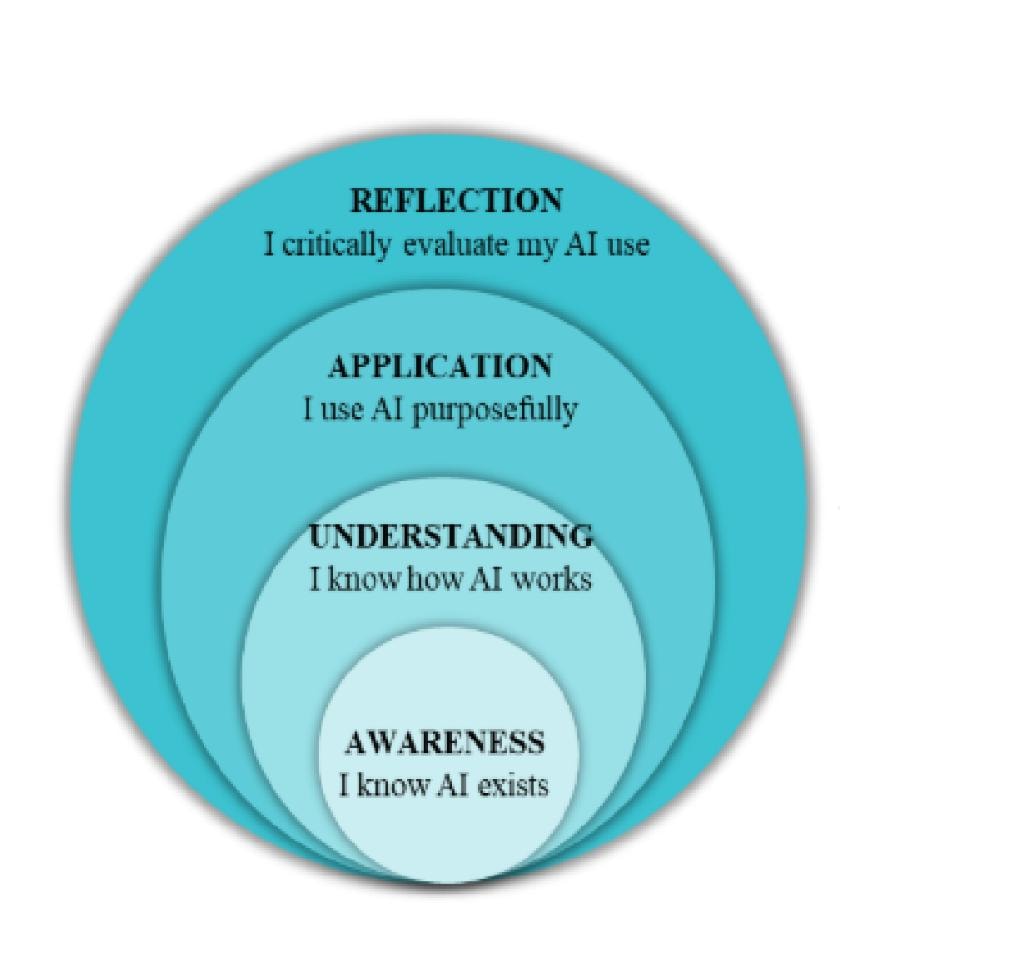
One structured response to these questions is the New Knowledge Help (NKH) framework, developed specifically for faculty research education in health professions. Naeem et al. (2026) propose the NKH approach as a model for ethical AI engagement, representing progression through four concentric levels of AI literacy: Awareness ("I know AI exists"), Understanding ("I know how AI works"), Application ("I use AI purposefully"), and Reflection ("I critically evaluate my AI use"). The diagram is deliberately layered: each outer ring builds on the one within it, and the outermost level, Reflection, is positioned as the goal rather than an optional add-on. This architecture makes an important argument. Technical familiarity with AI tools is necessary but not sufficient. What health-professions educators ultimately need is the capacity to stand back from those tools, to interrogate their outputs, to question their assumptions, and to ask whether AI use in a given context is genuinely serving the learner or merely serving convenience. The NKH framework is notable for centring ethical engagement rather than technical proficiency as the primary goal, a distinction that has significant implications for how AI literacy is taught and assessed in faculty development programmes.
Conclusion
AI in health-professions education is neither a panacea nor a threat to be feared. It is a set of tools, powerful, imperfect and value-laden, that require the same critical engagement we bring to any educational intervention. The educators who navigate this landscape most effectively will be those who combine technological literacy with a clear-eyed commitment to what education is ultimately for: the formation of capable, compassionate, reflective health professionals.
References
Bates, T., Cobo, C., Mariño, O., & Wheeler, S. (2020). Can artificial intelligence transform higher education? International Journal of Educational Technology in Higher Education, 17(1), 42. https://doi.org/10.1186/s41239-020-00218-x
Bleakley, A. (2014). Patient-centred medicine in transition: The heart of the matter. Springer.
Frenk, J., Chen, L., Bhutta, Z. A., Cohen, J., Crisp, N., Evans, T., Fineberg, H., Garcia, P., Ke, Y., Kelley, P., Kistnasamy, B., Meleis, A., Naylor, D., Pablos-Mendez, A., Reddy, S., Scrimshaw, S., Sepulveda, J., Serwadda, D., & Zurayk, H. (2010). Health professionals for a new century: Transforming education to strengthen health systems in an interdependent world. The Lancet, 376(9756), 1923-1958. https://doi.org/10.1016/S0140-6736(10)61854-5
Kung, T. H., Cheatham, M., Medenilla, A., Sillos, C., De Leon, L., Elepaño, C., Madriaga, M., Aggabao, R., Diaz-Candido, G., Maningo, J., & Tseng, V. (2023). Performance of ChatGPT on USMLE: Potential for AI-assisted medical education using large language models. PLOS Digital Health, 2(2), e0000198. https://doi.org/10.1371/journal.pdig.0000198
Luckin, R., Holmes, W., Griffiths, M., & Forcier, L. B. (2016). Intelligence unleashed: An argument for AI in education. Pearson.
Meskó, B., & Topol, E. J. (2023). The imperative for regulatory oversight of large language models (or generative AI) in healthcare. npj Digital Medicine, 6(1), 120. https://doi.org/10.1038/s41746-023-00873-0
Naeem, N. K., Naeem, Z. F., & Anwer, A. (2026). Ethical engagement with artificial intelligence in faculty research education: Evaluation of the New Knowledge Help (NKH) approach. BMC Medical Education. Advance online publication. https://doi.org/10.1186/s12909-026-09405-2
Zawacki-Richter, O., Marín, V. I., Bond, M., & Gouverneur, F. (2019). Systematic review of research on artificial intelligence applications in higher education: Where are the educators? International Journal of Educational Technology in Higher Education, 16(1), 39. https://doi.org/10.1186/s41239-019-0171-0