There is a conversation that happens at international health professions education conferences that I have grown increasingly impatient with. Someone presents a framework — competency-based medical education, entrustable professional activities, programmatic assessment — and the implicit assumption is that this framework is universal. That it applies everywhere. That the task for everyone in the room is implementation.
The question of whether the framework was built for contexts like mine rarely comes up.
The Provenance Problem
The dominant frameworks in health professions education were developed in North America, Western Europe, and Australia. They were built in contexts with stable health systems, well-resourced training environments, small group teaching ratios that most of the world cannot replicate, and faculty development infrastructure that does not exist in most low- and middle-income countries.
This is not a criticism of the frameworks themselves. Many of them are genuinely valuable. But their provenance matters. A competency framework built around the assumption that a trainee will have regular, structured feedback from a dedicated supervisor does not translate cleanly into a context where one supervisor may be responsible for thirty trainees, where clinical load leaves no time for structured observation, and where the concept of a protected teaching session is aspirational rather than real.
The Adaptation Trap
The standard response to this is: adapt the framework to your context. And this is reasonable advice, as far as it goes. But adaptation is not the same as co-creation. When the starting point is always a framework built elsewhere, the implicit message is that the knowledge produced in high-income contexts is the knowledge, and everyone else's job is to make it fit.
This shapes what gets published, what gets cited, what gets treated as evidence. Research conducted in low- and middle-income contexts is systematically underrepresented in the journals that set the agenda for the field. The result is a body of evidence that reflects a narrow slice of the world's health professions education reality and is then applied globally.
What Is Actually Needed
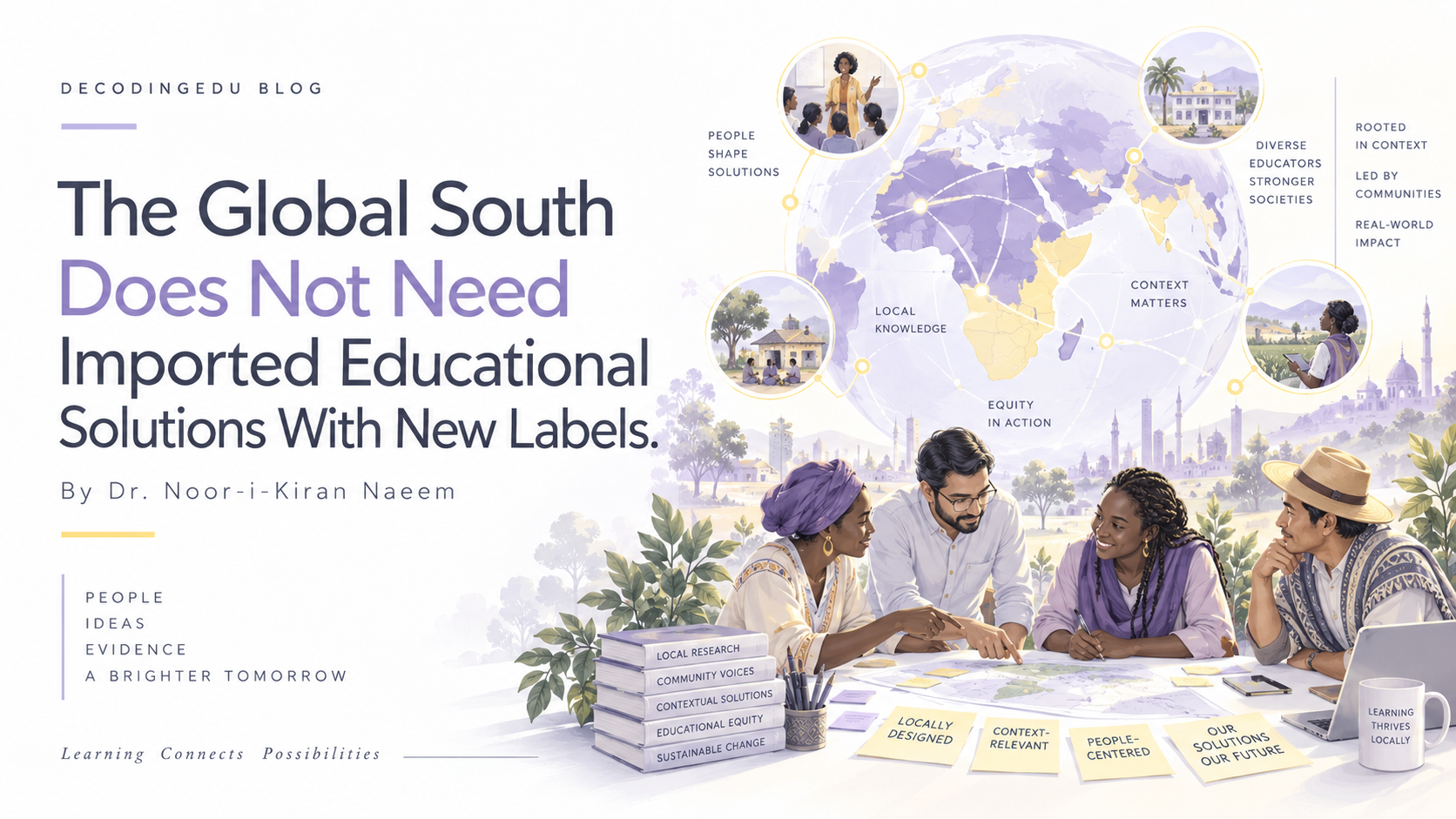
What is needed is not better adaptation. It is investment in knowledge production from within Global South contexts — research that starts from the problems and constraints of those contexts, that builds frameworks grounded in their realities, and that contributes to the global evidence base rather than simply consuming it.
It also requires a different kind of humility from the field's established institutions. An acknowledgement that the frameworks they have built are not universal — that they reflect particular contexts, particular assumptions, particular resource levels — and that the field will be stronger when it draws on a genuinely global range of evidence.
DecodingEdu exists, in part, because I wanted to build something that took this seriously. Not as a political statement, but as a practical one. The educators I am trying to serve are working in contexts that the dominant literature largely ignores. They deserve resources built for their reality, not adaptations of resources built for someone else's.