I have spent most of my career inside medical education systems — as a student, a teacher, a curriculum designer, and eventually as someone who was asked to lead. And in every role, I noticed the same thing.
The people doing the work — the faculty, the clinical supervisors, the programme directors — were deeply committed. They showed up. They cared. But they were largely working alone, without frameworks, without community, and without the kind of professional development that matched the complexity of what they were being asked to do.
We were training doctors with rigour. We were not training the people who train doctors with anywhere near the same rigour.
The Gap That Would Not Go Away
I kept encountering educators who had never been taught how to write a learning objective that actually drove assessment. Faculty who had been running small group sessions for years but had never had a conversation about facilitation theory. Programme directors who were redesigning curricula without access to the literature on curriculum models.
This was not a failure of effort. It was a failure of infrastructure.
Health professions education is a discipline. It has its own body of knowledge, its own research base, its own debates. But most of the people practising it had never been formally introduced to that discipline. They had been handed a timetable and told to teach.
What I Wanted to Build
I wanted to build something that treated health professions educators as professionals in their own right — not as doctors who also happen to teach, but as educators who deserved the same quality of training they were expected to deliver.
I wanted it to be accessible. Not locked behind expensive conference registrations or postgraduate fees that most educators in the Global South could not afford. I wanted it to be practical — grounded in real problems, real contexts, real constraints.
And I wanted it to be honest about what we do not yet know. Education is not a solved problem. The field is full of contested ideas, evolving evidence, and genuine uncertainty. I wanted DecodingEdu to hold that complexity rather than flatten it.
Why Now
The pandemic accelerated something that was already happening. Educators were suddenly being asked to teach online, to redesign assessments overnight, to support students through unprecedented disruption — all without preparation.
It made the gap impossible to ignore.
It also created an opening. Educators who had never engaged with professional development before were suddenly looking for it. The appetite was there. The infrastructure was not.
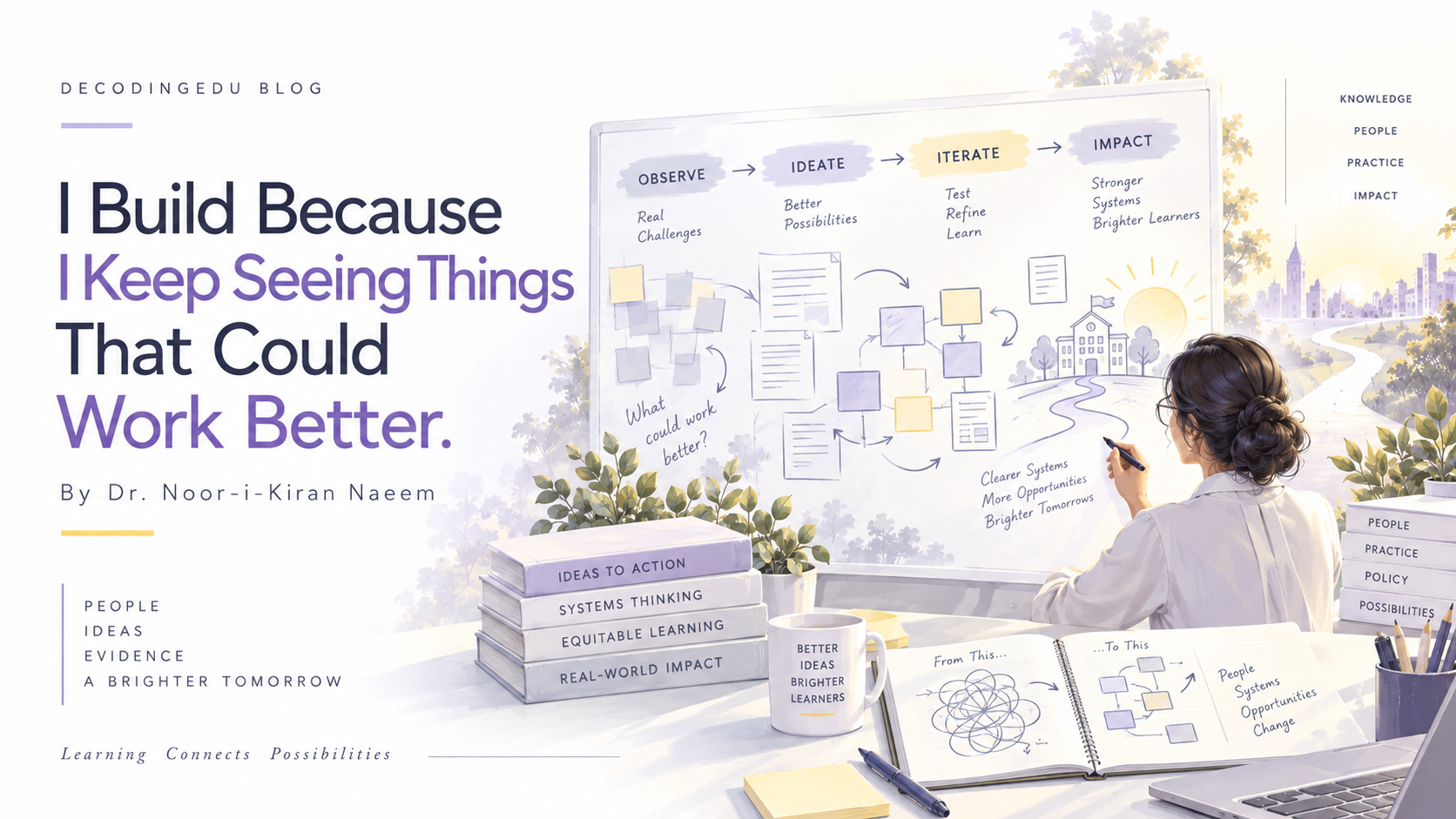
DecodingEdu is my attempt to build that infrastructure — not perfectly, not completely, but seriously. With the belief that when we invest in educators, we invest in every learner they will ever teach.
That is why I built it.