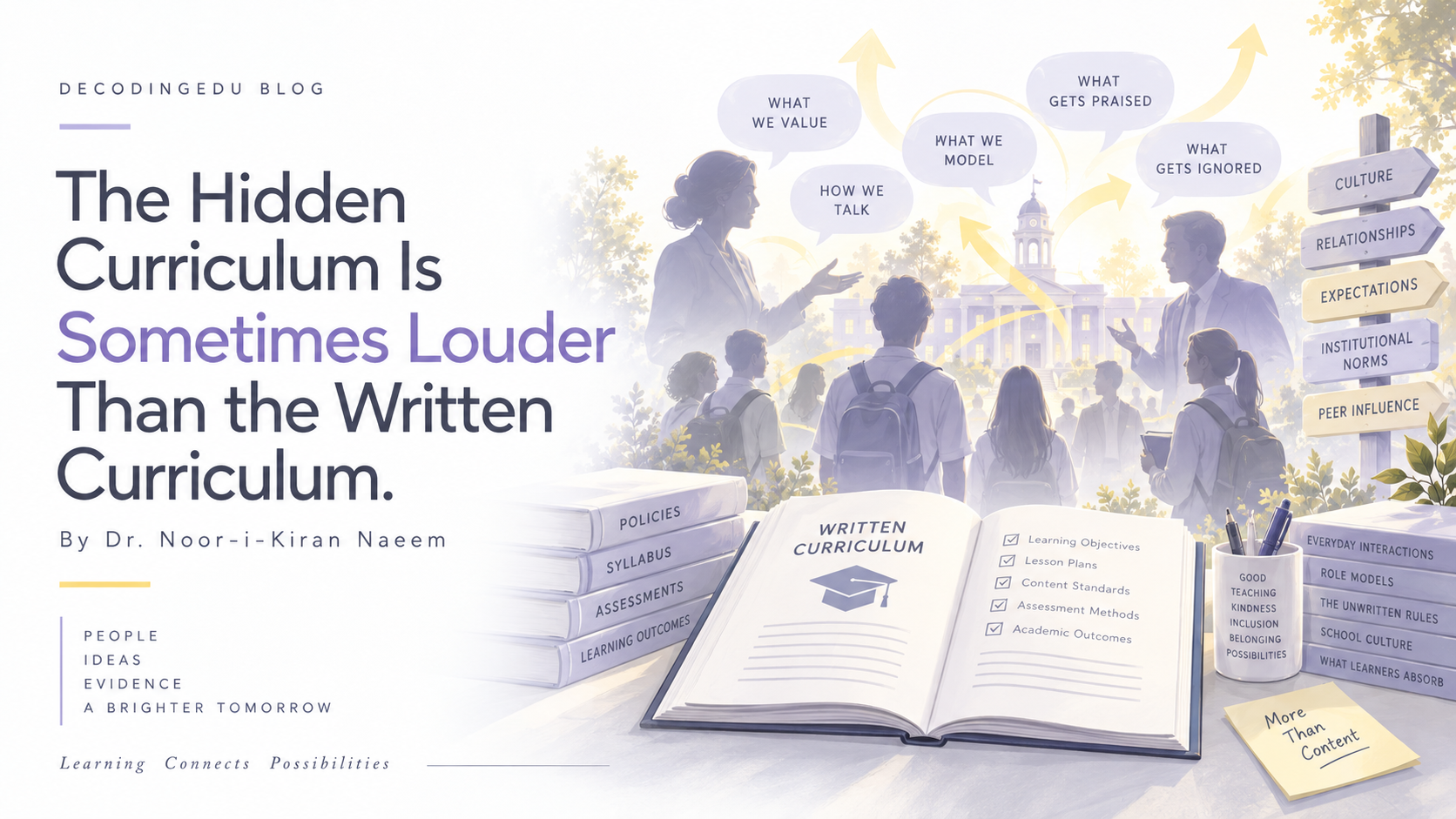
Every curriculum has two versions. There is the one that appears in the programme handbook — the learning outcomes, the module descriptors, the assessment schedule. And then there is the one that students actually experience.
The second version is the hidden curriculum. And in health professions education, it is often more powerful than the first.
What the Hidden Curriculum Teaches
The hidden curriculum is transmitted through everything that is not explicitly taught. It lives in the way a senior clinician speaks about a patient in a corridor. In whether a student who raises a concern is praised or quietly sidelined. In which behaviours get rewarded in assessments and which get overlooked. In who gets called on in tutorials and who does not.
Students are extraordinarily good at reading these signals. They learn, very quickly, what is actually valued — as distinct from what the programme says is valued. And they adapt accordingly.
This is not a new observation. Philip Jackson named the hidden curriculum in 1968. Frederic Hafferty brought it into medical education in the 1990s. The literature is substantial. And yet, in most faculty development conversations I have been part of, it barely comes up.
Why It Matters More Than We Acknowledge
Consider what the hidden curriculum teaches about hierarchy. In many clinical training environments, the formal curriculum says: ask questions, speak up, patient safety is everyone's responsibility. The hidden curriculum says: know your place, do not challenge seniors, survival depends on not making waves.
Students do not need to be told which message to follow. They observe what happens to people who follow each one.
Or consider what it teaches about uncertainty. The formal curriculum may include sessions on clinical reasoning and diagnostic uncertainty. But if every consultant the student observes projects absolute confidence — if admitting uncertainty is treated as weakness — the hidden curriculum teaches that uncertainty is something to hide, not something to name.
These are not minor distortions. They shape professional identity. They shape patient safety culture. They shape whether a future clinician will speak up when something is wrong.
What Educators Can Do
The first step is simply to become aware of it. To ask, honestly: what are students learning from watching me? What do my responses to their questions teach them about intellectual safety? What does the way I run a ward round teach them about how patients should be spoken about?
The second step is to make the hidden curriculum visible — to name it explicitly with students. To say: you may notice that what I am about to describe is not always what you see in practice. Let us talk about that gap.
This is uncomfortable. It requires educators to acknowledge that the environment they work in is not always aligned with the values they are trying to teach. But that discomfort is productive. It is far better than pretending the gap does not exist while students learn, quietly and efficiently, to navigate it.
The hidden curriculum will always exist. The question is whether we are paying attention to what it is teaching.